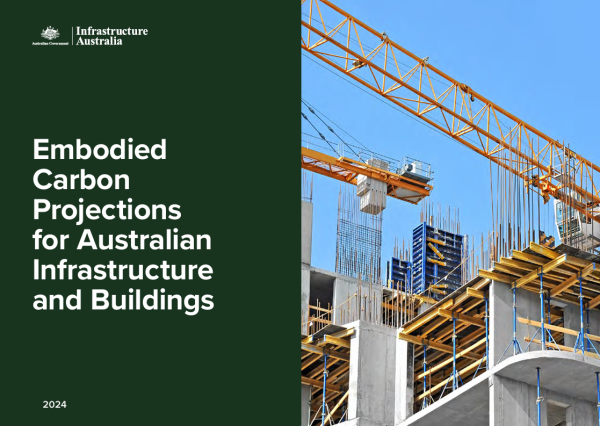
The built environment is directly responsible for nearly one-third of Australia’s total carbon emissions and contributes to over half of all emissions. The carbon embodied in materials and the construction process contributes 10% of Australia’s national footprint, the report Embodied Carbon Projections for Australian Infrastructure and Buildings released by Infrastructure Australia this week has found. About 7% of this is locked in before the asset ever comes into operation.
Supporting Australia to reach net zero goal
The report forms part of Infrastructure Australia’s broader work program and advice to support the Australian Government to meet its goal to be net zero by 2050. This is the first time a model has been created for the upfront embodied carbon emissions of Australia’s buildings and infrastructure pipeline for the next five years (to 2026/27).
The report found that 23% of this embodied carbon can be reduced by 2027 by employing practical decarbonisation strategies.
thinkstep-anz provided the analysis and modelling for the report and supported the industry engagement. Project partner Slattery costed the decarbonisation strategies. ‘We are proud to have contributed to the report. Its findings can help to lower Australia’s national carbon emissions by 2% this decade with practical decarbonisation strategies,’ thinkstep-anz’s Technical Director Jeff Vickers said.
Finger on the pulse of industry
Infrastructure Australia and the Department of Climate Change, Energy, the Environment and Water (DCCEEW) invested time and effort in engaging deeply with industry. The result is data that are not only valuable for predicting the upfront embodied carbon in Australia’s Infrastructure pipeline but also for many future research projects to build on.
‘The report has its finger on the pulse of Australian industry and contains insights from relevant stakeholders. It includes what needs to be done by policymakers and government to support industry to reduce upfront embodied carbon,’ thinkstep-anz’s Impact Director Nicole Sullivan said.
The data sets an important baseline and shows future possibilities. For example, the report gives a detailed picture of the uptake rates of different technologies in Australia’s states in 2023 and forecasts these for 2027.
Opportunities to reduce emisions
By including marginal abatement cost curves, the report shows the cost (or cost saving) of a strategy relative to its ability to reduce carbon emissions and highlight which strategies are cost effective.
The report also includes:
→ Suggested policy interventions, ranked on importance, difficulty and timing, to help governments set priorities.
→ Data in the annexes can be used to help further standardise how to measure and calculate embodied carbon in Australia.
Learn more about embodied carbon here
Read the report here
If you would like to receive the full technical report, with all appendices please contact us directly and we can provide you with the report.